

What We Call It
Sharmilla Ganesan continues FED's special celebration of Malaysian Deepavali stories


Tomato, tomahto. Deepavali, Diwali. What we call it matters. What we call it heralds a perspective. Perspectives are worth noting, honoring. Perspectives and their infinite variation offer richness, possibility, and hope.
This season FED celebrates Malaysian Deepavali stories through and with three incredible women—Sumitra Selvaraj, Sharmilla Ganesan, and Preeta Samarasan—all writers and all also many other things as so many—all?—women are.
The festival and the season celebrate light. They are variously described as a triumph of good over evil, knowledge over ignorance, and the spiritual victory of Dharma over Adharma. But, they are so much more. They are personal.
FED acknowledges the conventional precedents, glosses, and adds that our celebration is about particularity and about creating the space for joy, for being seen, known, and loved. We celebrate the persistence of particular voices, especially those that have been sidelined and dismissed, rendered invisible, and worse.
With gratitude for this particularity, we bring you the second installment of FED Deepavali—the Tamil spelling and the Malaysian-Indian experience coaxed, encouraged, and envisioned for the magazine by FED Writing Editor, Preeta Samarasan. Today, Sharmilla Ganesan. And, for Sumitra Selvaraj’s installment last week plus Preeta’s intro to the series, click here. Then, stay tuned for Preeta’s own installment next week.
Let there be light.
Big love, Ashley ❤️
Sharmilla Ganesan: Twisted
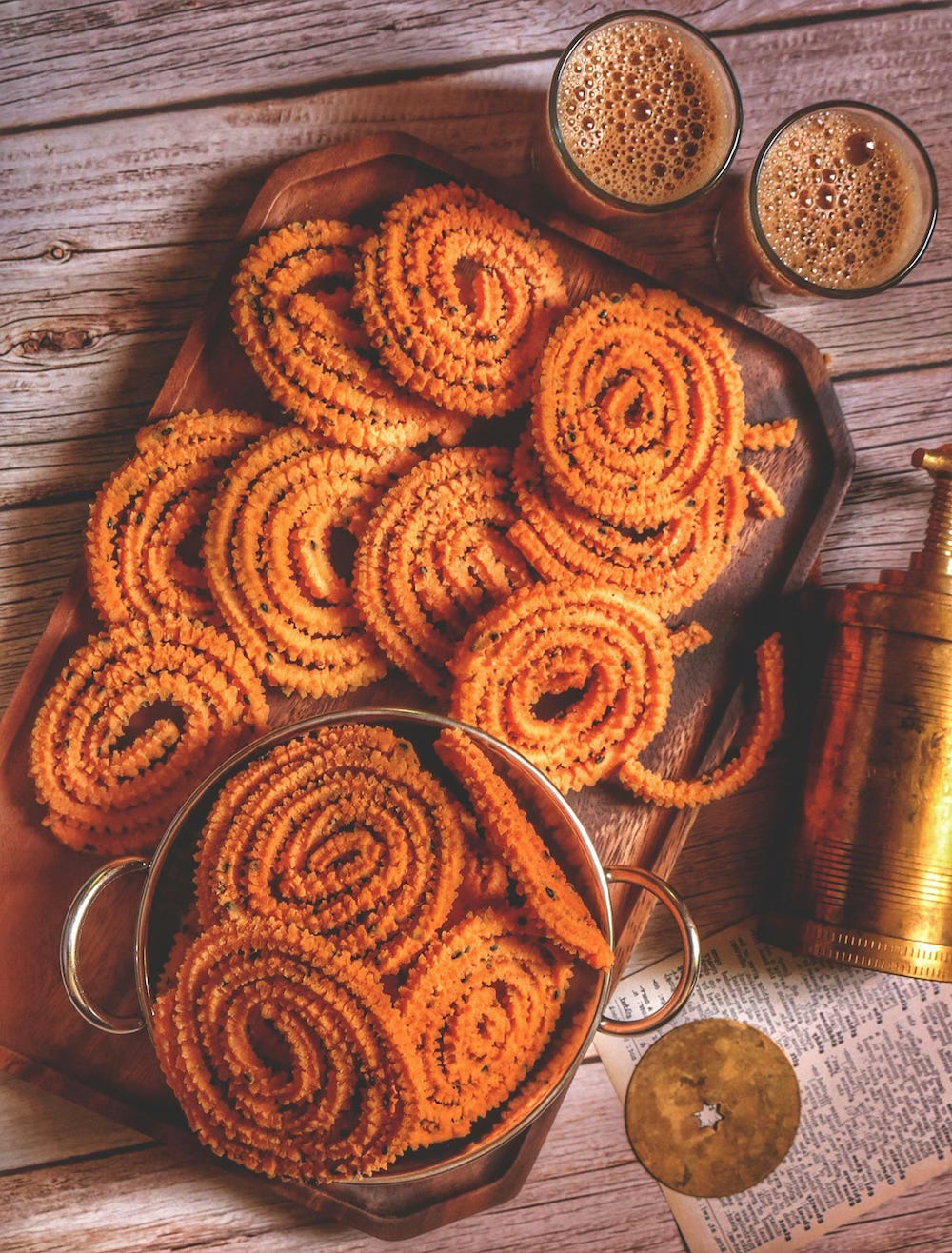
It’s 1991, and my Standard 2 teacher Puan Roslina tells the Indian kids in class to bring some Deepavali snacks when we come back from the public holiday. For everyone to try, she says. I think about the two tins of murukku I’ve already requested Amma to keep aside for my classmates, and I’m excited!
It’s 2025, and I’m discussing-verging-on-arguing with a friend from India about what exactly counts as murukku. I say the word is a broad category rather than one specific thing: of deep-fried, crunchy, savoury snacks that are South Indian in origin, typically using rice flour and black gram flour as a base, all spirals or curls or squigglies, and usually associated with festivals or weddings.
He argues that only those curled, perfectly spiralled ones - I know those as kai murukku, “kai” meaning hand, because they’re shaped by hand rather than an implement - are called murukku. And that all the others are different, specific snacks with their own names - thenkuzhal, omapodi, ribbon pakodam, etc. It ends with me calling him ignorant, and him calling me Madam Murukku.
It’s 1988, a week before Deepavali. The air is thick with the aroma of deep-frying dough and spices. The kitchen is bubbling with activity: Paati and Amma are both in various stages of murukku-making while trying to stay out of each other’s way. There are large milk powder tins on every available surface in the kitchen and storeroom, just waiting to be filled - they are specifically designated, for thenkuzhal, ribbon pakodam, and omapodi.
Thatha and I are sitting at the kitchen table, sampling early murukku iterations for quality control. He is explaining to me that the word “murukku” means twist or coil in Tamil, because of the way so many types of murukku are in spirals. He gives an example: like when men with huge, proud moustaches coil up the ends, it’s called “murukku”-ing their moustaches.
It’s 1994. We’re not celebrating Deepavali this year, because Thatha passed away a few months ago. So we’re not making any murukku in the house. Luckily, there’s a loophole: Amma’s parents are technically a “different” family, so we get tins of Deepavali murukku sent over from them. Just to eat though, not to celebrate.
It’s 2017. I randomly think of the word thenkuzhal, and for the first time, realise it’s a compound word: “then” meaning honey, and “kuzhal” meaning flute or pipe. Why, I wondered, when this murukku was decidedly not sweet - though its signature airy crunch was because each coil was hollow within, like a kuzhal. I theorise that perhaps eating thenkuzhal is so deliciously pleasurable, it feels like you’ve eaten honey.
This thought leads me down a murukku etymology rabbithole. Omapodi is easy, of course: “omam” or carom seeds flavour the dough, and “podi” (meaning powder) refers to its fine, light squiggles. Similarly, mullu murukku is self-explanatory: “mullu” means thorn, and this varietal of murukku is characterised by its spiky texture. But ribbon pakodam? “Pakoda” could refer to any number of deep-fried, fritter-y foods. However, ribbon is an obviously borrowed, colonial-era word. So what was this flat, loopy, spicy murukku called prior to the English invasion?
It’s 1990. My sister and I are sitting on the kitchen floor with Paati, who has sheets of newspaper laid out in front of her. On them, she’s spread her full set of murukku-making equipment. She’s drying them, before packing them away till next Deepavali (though sometimes we get lucky, and she gets an inclination to make some out-of-season murukku).
The murukku pizhi, a hollow wooden cylinder with handles on both sides, with a matching press that fits into the hole in the middle. A variety of round brass plates that fit into the bottom of the cylinder, each with holes of different shapes and sizes, to produce the different types of murukku. You place the desired brass plate into the bottom of the cylinder, fill the hollow with your murukku dough, and use the press to squeeze out the type of murukku you desire. My sister and I agree that it works exactly like our Play-Doh pressing machine.
It’s 2021, and my Amma asks us if it’s okay to not make any murukku for Deepavali this year, because she finds it too tiring. Of course it’s okay, we say; we can always order some. It really is okay, except for that little catch in my throat I feel when I think about how I never learnt to make them from her - and that sometime in the not-distant future, I won’t be able to. She ends up making a few tinfuls anyway, and I’m happier than I’m able to express.
It’s 2002, and we’re clearing out the kitchen. As I help Amma repack a box of seasonal implements, our old murukku pizhi catches my eye. The wood has been worn completely smooth, the grain patterns almost shiny from decades of hands holding and pressing over them. My Amma’s hands. My Paati’s hands, until she didn’t have the strength to any longer. Amma looks over and says not to pack them away, she still uses them for Deepavali.
It’s 2022, two weeks after Deepavali. My childhood friend Lalitha and I are drinking G&Ts at my apartment, and we’re craving a snack. I dig out the last of my ribbon pakodam stash that Amma made. Lalitha is ecstatic; she loves ribbon murukku, she says (that’s what they call it in her family).
We come up with an idea most definitely fuelled by the drinks: there’s a jar of fresh, garlicky toum in the fridge, we should dip the pakodam in it. What a combo they are! We both agree that we might have invented the best snack ever.
It’s 2023, and I’m at Lalitha’s home a few days after Deepavali. She serves me ribbon pakodam, and announces that it’s my mother’s recipe. Lalitha says she called and got the recipe from her because it’s the best she’s tasted. Lalitha and her husband spent a day attempting and finally succeeding at making them. Crunching through handfuls of them fills up much more than my belly.
It’s 1991 and we’re back at school after the Deepavali public holiday. Puan Roslina has set up a little table at the side, and us Indian kids deposit our snacks there. I brought ribbon pakodam and thenkuzhal. Someone else brought mullu murukku and kai murukku. There’s also sugee laddoo, athirasam, and various types of biscuits.
When Puan Roslina asks me what I’ve brought, I say “murukku” - because I think it’s less confusing to use the general term. She looks into my tins and says, “Ohhh maruku!” So I correct her, it’s “murukku”, a food item we usually make for Deepavali. “No lah, it’s maruku!” she insists.
I look at her, uncertain how to respond. I want to tell her I know what it’s called, and that everyone else I know - other adults! - call it that too. But she was already losing interest, and moving on to the next student. “Maruku, I know already! We Malays also have,” she says, as she walks on.
Sharmilla Ganesan is a Malaysian writer whose work intersects themes of culture, migration, gender, and the Indian diasporic identity. Her short fiction has appeared in numerous local and regional anthologies, and she was the winner of the 2022 Malaysian Short Story Writing Competition. In her day job, Sharmilla has, at various points, been a journalist, radio host, and arts critic.

FED is a participant-supported publication and community. We rely on you and the power of your generosity to create community and sustain this project for all.
How it works…
All are welcome at the table, and “Free” subscriptions are offered to every subscriber as a gift from readers who have upgraded to a paid subscription and from the contributors, editors and producers of FED.
Every subscriber—you, too!—is invited and encouraged to pay the gift forward by upgrading to a paid subscription. Your participation is essential to the whole.
Together, we create one great circle of giving and receiving that binds us together in nourishing community.
So, please, upgrade your subscription to paid today, and share the FED bounty!
For more goodies…
Be sure to check out all the wonderful contributions added to the FED table since our launch on the vernal equinox of 2024. Our global collection of musicians, artists, writers, growers, gleaners, cooks, and craftspeople cook up a smorgasbord of aesthetic and literal nourishment for your body and soul. Yum!
 | A guest post by
|